If you’re anything like me—a bit of a gadget lover—you’ve probably tried your fair share of “smart home” devices. Some are fun for a week. Some are too complicated to keep using. But if you’re just getting started, there’s one category I always come back to: smart lighting for home. It’s not the most high-tech. But it’s the one that consistently makes daily life easier in ways you don’t expect.
One thing in particular made that very clear to me. My aunt was home alone one evening when she suddenly heard something moving in the garage. Not loud—just enough to make you stop and listen twice. The kind of sound that makes your brain immediately jump to worst-case scenarios. She froze for a moment. Didn’t want to go check. Didn’t know what to do. Then she remembered the smart light installed in the garage, so she opened her phone and turned it on remotely. The light came on instantly—and the noise stopped.
Just like that.
To this day, she still doesn’t know what it was. Let’s hope it was just some stray animal—maybe a wandering cat or something small—and not anything worse.
But the point is, in that moment, she didn’t have to guess or put herself at risk. A simple lighting gadget gave her control when she needed it most. That’s when I started seeing smart lighting differently. Not as “nice to have,” but as something that quietly solves very real situations.
Why Smart Lighting Feels More Useful Than It Looks
A lot of these devices don’t look impressive. A small sensor. A bedside lamp. A remote control.
But what they actually do is remove tiny, repeated inconveniences:
That harsh light at night that fully wakes you up
That one switch you’re too comfortable to get up for
That dark space you don’t want to walk into
That moment of uncertainty when something feels off
And instead of you adjusting your behavior, the lighting adjusts to you.
That’s what makes these true “gadgets ideas”—not flashy, but quietly effective.
An Ambient Sleep Lamp That Helps You Switch Off
£39.50 £43.36

Why It's Worth Trying
When people think about lighting, they usually think about brightness. But before bed, the atmosphere matters just as much.
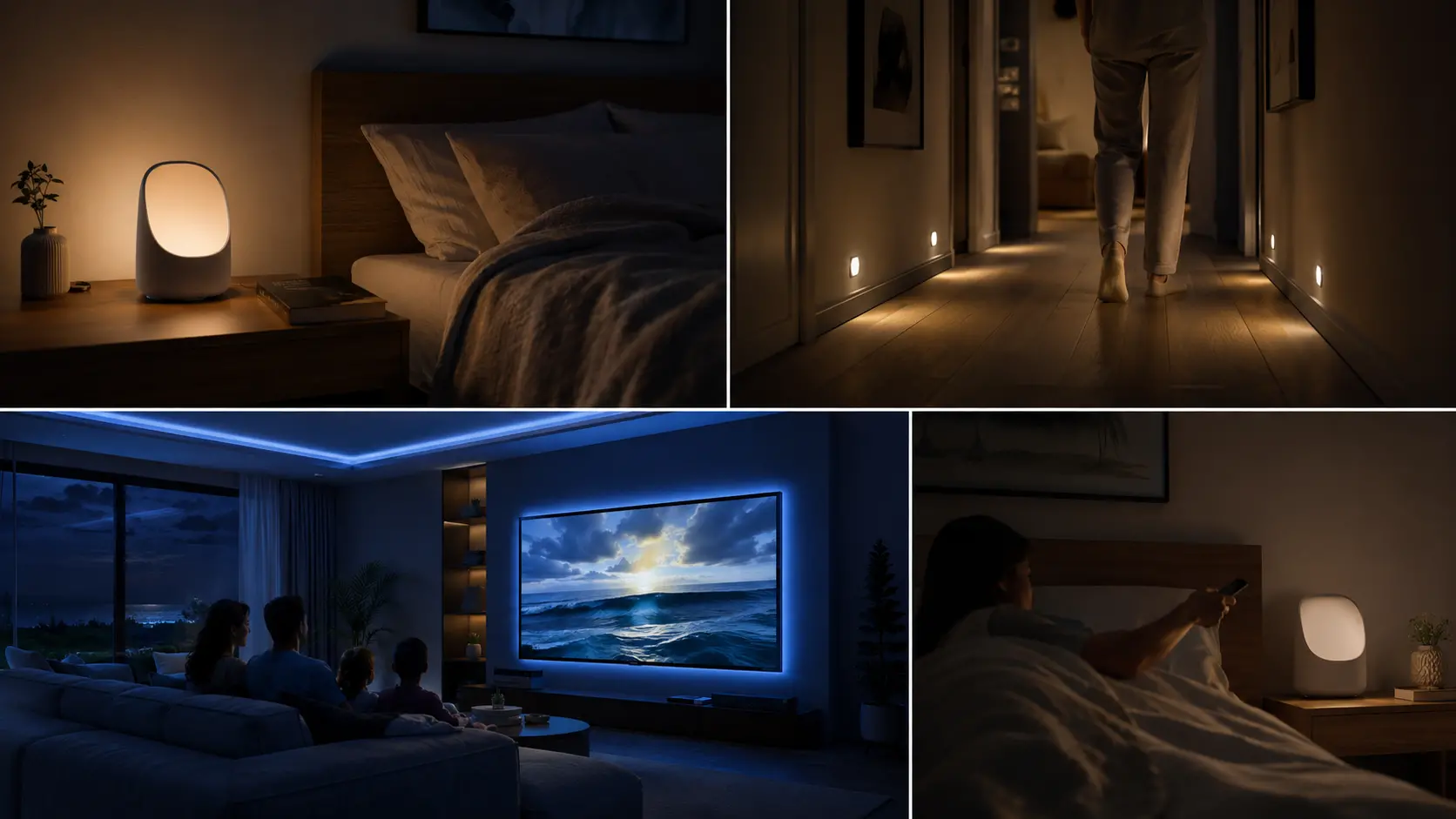
I recently came across a sleep lamp designed to look like a small boat floating on water. Instead of staying at one fixed brightness, the light changes gradually over time, creating a much softer visual experience than a typical bedside lamp.
Many models also combine features like:
Gentle ambient lighting
Gradual dimming
White noise, such as rainfall or ocean waves
Sleep timers that turn everything off automatically
None of these features will magically cure poor sleep. But they can make it easier to separate "I'm still awake" from "it's time to wind down," especially if you're trying to spend less time staring at your phone before bed.
Note From Real Life
Some home gadgets get put away after the novelty wears off. This is usually the opposite. People often end up using it every evening—not because it's packed with technology, but because it quietly becomes part of the bedtime routine.
Motion-Sensing Night Lights That Work Without Being Noticed
£21.00 £26.89

Why It's Worth Trying
Most people don't realize how many times they move through the house after dark until they stop reaching for light switches.
A motion-sensing light turns on automatically when you walk past and switches itself off a short time later. It sounds like a small convenience, but it's surprisingly easy to get used to.
They're especially useful in places where you rarely want full brightness:
Hallways
Bathrooms
Staircases
Garages
Walk-in closets
Under kitchen cabinets for late-night snacks
Unlike turning on the main ceiling light, a soft motion light gives you just enough visibility without making your eyes adjust to a bright room. That means it's easier to fall back asleep after a midnight trip to the bathroom.
Note From Real Life
This is one of those gadgets you stop noticing after a week—which is actually the biggest compliment you can give it. Good smart lighting shouldn't constantly remind you it's "smart." It should quietly do its job until the day you stay somewhere without it and suddenly realize how often you miss it.
A Smart Ceiling Light That Changes With What You're Doing
£45.24 £60.89

Why It's Worth Trying
A lot of us treat room lighting as something fixed. You install a bulb, switch it on, and that's the lighting for everything.
A smart ceiling light takes a different approach. Instead of forcing one setting to fit every situation, it lets the room adapt to what you're doing.
Brighter, cooler light can help when you're working, studying, or cleaning. Warmer, softer light feels more comfortable for watching TV, eating dinner, or relaxing in the evening.
You probably won't adjust it every hour. But having the option means one room can feel noticeably different without adding extra lamps or changing bulbs.
Note From Real Life
This is the feature many people underestimate before buying. Adjustable brightness sounds useful on paper, but adjustable color temperature is often what people end up appreciating most. Once you've spent a few evenings under warmer light instead of harsh white lighting, switching back can feel surprisingly uncomfortable.
Remote-Control Lighting That Supports Better Habits
£12.64 £18.87

Why It's Worth Trying
I used to think remote-controlled lights were one of those features that sounded nice but weren't actually necessary. After all, walking across the room to flip a switch isn't exactly difficult.
But convenience isn't really the point.
The problem is that tiny interruptions have a way of breaking routines. A friend of mine wanted to stop scrolling on her phone before bed, so she started leaving it in the living room and reading instead. The habit worked—until it was time to turn off the light.
Getting back out of bed felt like such a small thing, but it was enough to make her reach for her phone "just for a second." You can probably guess how that ended.
Switching to a remote-controlled bedside light removed that last bit of friction. Now she finishes a chapter, reaches over, clicks one button, and goes straight to sleep.
Sometimes the smartest upgrade isn't the one that automates everything. It's the one that makes a good habit just a little easier to keep.
Note From Real Life
People often buy smart lighting expecting dramatic automation. In reality, the features that get used every single day are usually the simplest ones. A remote beside the bed sounds almost old-fashioned—but because it never depends on unlocking your phone or opening an app, it's often the faster option.
How to Start Without Overcomplicating It
You don’t need a fully automated home.
Start with one situation that annoys you the most:
Struggling to sleep → try an ambient or sleep-focused lamp
Moving around at night → add motion lights
Too lazy to get up and switch lights → start with remote control
Think of each device as solving one specific problem. That’s enough.
The Real Shift
None of these gadgets will dramatically change your home overnight.
But over time, something subtle happens: Things feel easier.
You move through your space without thinking about lighting. Nights are less disruptive. Small actions take less effort.
And that’s why smart lighting for home stands out in 2026. Not because it’s flashy—but because it works, quietly, in the background.