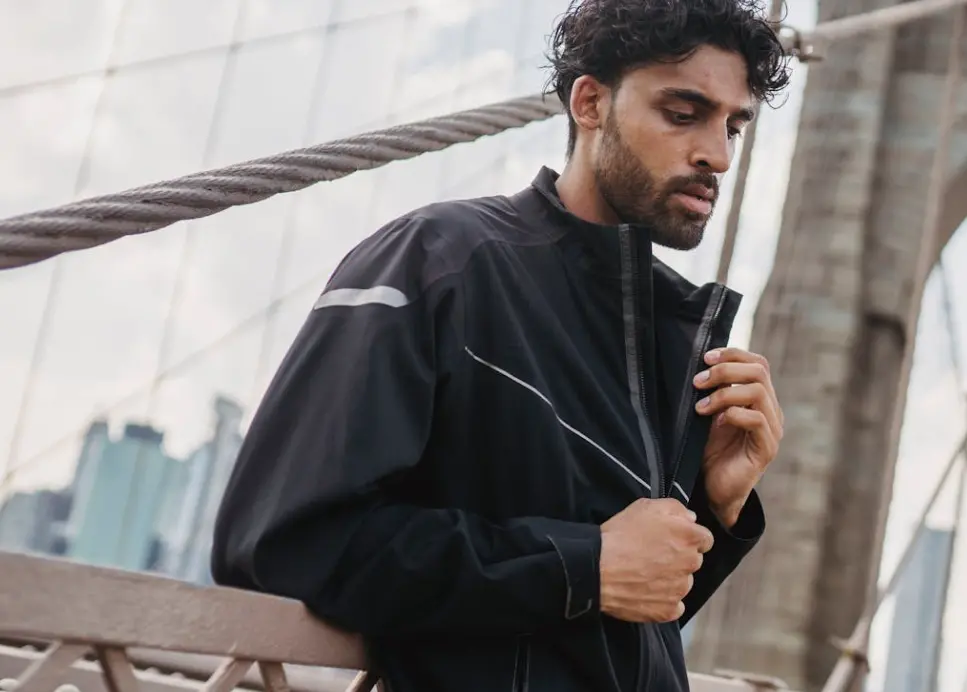
That moment right after you step outside tells you everything. The air feels sharp on your skin, wind slips through your sleeves, and for a second you think you’ve underdressed. Ten minutes later, you’re moving, warming up, and suddenly that extra layer feels like a mistake. Then you stop—at a crossing, for a break—and the chill comes back twice as fast.
That cycle is exactly what a running windbreaker is built for. Not “weather protection” in theory, but real, slightly annoying temperature shifts your body keeps going through.
And if you’ve worn one enough, you’ll notice something else—it doesn’t stay in your running kit for long. It starts showing up on coffee runs, short walks, even commutes. Same logic, just lower intensity.
Quick Spec Primer (Only What Actually Matters)
You don’t need a full tech sheet, but a few numbers tell you whether a windbreaker is worth wearing:
Weight: 40–60g is the sweet spot. Above that, you’ll feel it once you warm up
Denier: 7D–20D ripstop keeps it light but usable (anything thicker starts to feel like a jacket, not a shell)
Breathability: around 10K g/m²/24h or higher, otherwise heat builds faster than you expect
Packability: if it doesn’t disappear into its own pocket, you’ll stop carrying it
That’s really it. Everything else is detail.
#1 Early Run Essential: Lightweight 10D Shell (Cold Start Control)
Early runs are always the same—you’re cold for the first few minutes, and the wind feels worse than it actually is. This is where a lighter running windbreaker makes the biggest difference.
Best Pick Features
10D ripstop nylon, around 40–50g
Close, athletic cut that doesn’t flap in the wind
Minimal structure with a simple zip front
Optional hood that can be packed away quickly
Light DWR finish for mist or fog
Why This Works
At this stage, you’re not trying to stay warm—you’re trying to avoid that sharp, uncomfortable start. A lighter shell blocks just enough wind to make the first kilometre easier, then gradually becomes less noticeable as your body heats up.
The key is that it doesn’t trap heat. You shouldn’t feel the need to take it off immediately after warming up.
Formula
10D / ~45g + simple wind block
#2 Mid-Run Adapter: 15D Breathable Shell (When Conditions Shift)
Once you’re fully moving, things get less predictable. You’re generating heat, maybe sweating, but the environment isn’t stable—wind picks up, light rain starts, or the temperature drops in shaded areas.
This is where a more balanced running windbreaker matters.
Best Pick Features
15D ripstop fabric, around 50–60g
Noticeable breathability or built-in venting (back panel, underarm zones)
Light water resistance that handles drizzle without soaking through
Slightly roomier fit for airflow
Matte or soft finish that doesn’t feel overly “technical”
Why This Works
This type of jacket doesn’t fight your body—it adjusts with it. It lets heat escape when you need it, but still holds off wind and light rain. You’re not constantly zipping and unzipping or thinking about it mid-run.
And this is usually the point where it stops feeling like “just running gear.” The same features that help here—breathability, flexibility, light protection—are exactly what make it usable for everyday movement.
Formula
15D / ~55g + airflow + light weather protection
 Lightweight Quick-Dry Running Windbreaker
£47.81 £69.62
Shop at Voghion Weather-Ready Windbreaker for Windy Days
£18.17 £35.50
Shop at Voghion Lightweight Sun Protection Windbreaker
£26.88 £35.79
Shop at Voghion#3 Off-Run All-Rounder: Minimal 7D Shell (Where It Becomes Daily Wear)
This is the version most people end up wearing the most—just not always for running.
You throw it on after a run, or before heading out, and it just works. The only issue is how you style it. Because if everything else is also “performance,” you start to look like you’re on your way to a workout you haven’t committed to.
Best Pick Features
7D–10D lightweight shell, around 45–50g
Minimal design (fewer zips, less visible tech)
Softer fabric feel, less crinkly or shiny
Relaxed but still clean silhouette
Subtle reflective details rather than high-contrast panels
Why This Works
This is where the windbreaker shifts from function to habit. It’s easy to throw on, easy to carry, and doesn’t demand a full “running outfit” around it.
Pair it with cotton tees, chinos, or even denim, and it stops looking like gear. It just becomes a light outer layer that happens to perform well.
You’re not running—but you’re also not overdressed for moving through the day.
 Windbreaker for Running with Hood
£34.18 £47.95
Shop at Voghion Lightweight Hooded Windbreaker for Daily Wear
£27.03 £44.80
Shop at Voghion Lightweight Windbreaker for Everyday Runs
£35.17 £53.09
Shop at VoghionWhy These Styles Stick
A good running windbreaker doesn't solve one problem—it quietly handles the lot. That prickly cold start when skin screams for cover. The mid-run sweat surge demanding instant vents. The post-run cooldown where wind bites twice as hard. Even those in-between dashes—commute stops, park walks, sudden showers. One 45g shell adapts across all, no drama.
That's why it lives in rotation. Not some hyper-specialized gimmick, but a chameleon that shrugs off 9°C dawns, 22°C slogs, and coffee-run drizzle. Street-to-stride versatility without the faff.
Full Sportswear Stack + Where to Shop Smart
Nail that balance, then hit Voghion's sportswear section for the full stack.
Active clothing sets give matched tops+bottoms that move as one; active coats & hoodies layer windbreakers with zip-off options; pants and shorts (quick-dry, tapered) handle stride freedom; add base layers and socks for zero-chafe completeness.
No half-measures—run fully armed. Now lace up. That next gusty parkrun (or park stroll) won't stand a chance.