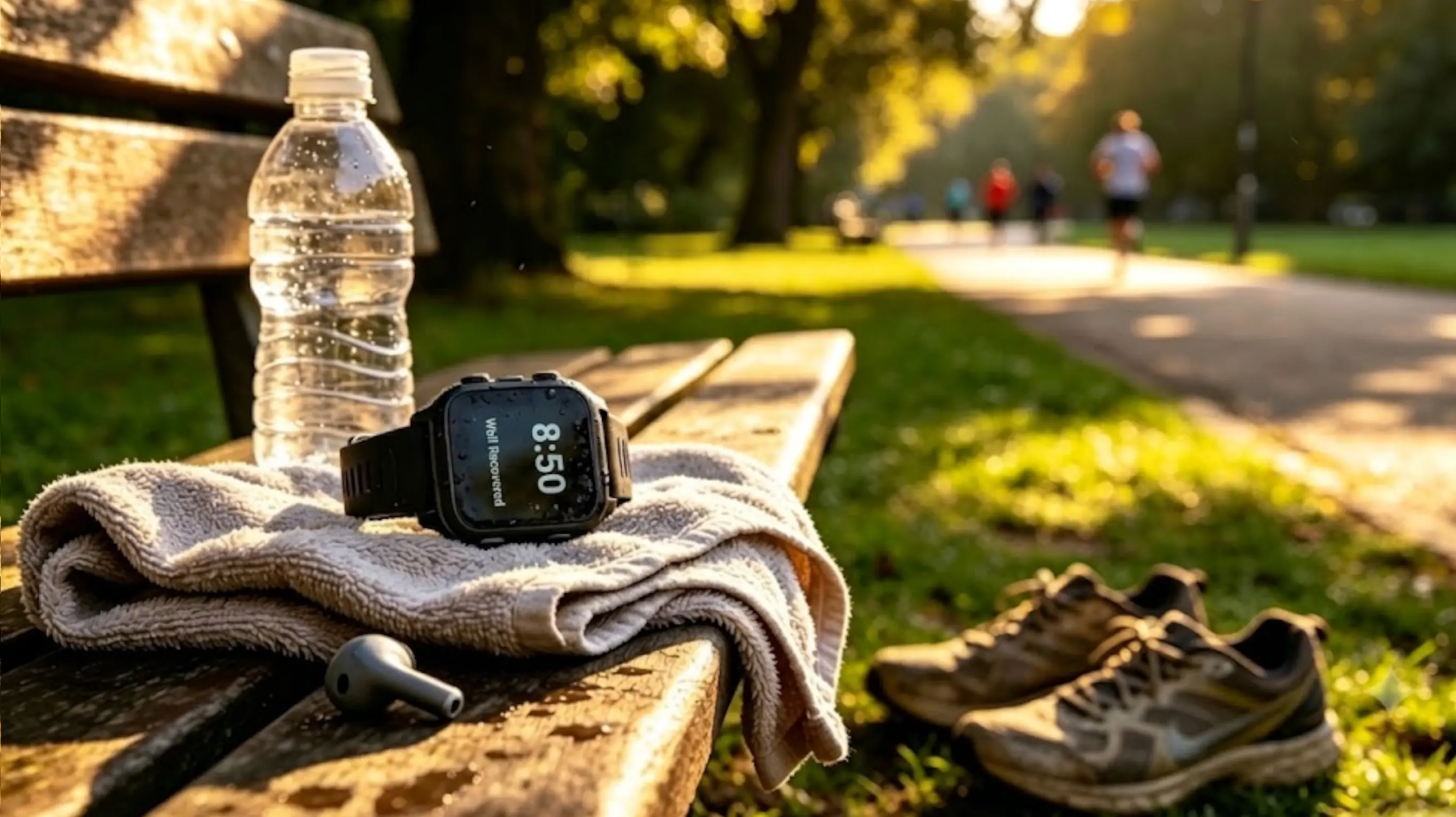
You might expect a guide like this to be packed with spec sheets, feature comparisons, and debates over which watch has the most advanced technology. In 2026, that's usually how fitness watch conversations go.
But running has never really been about having more features.
One of the reasons running remains so popular is because it's still one of the simplest ways to exercise. You don't need a gym membership, a complicated setup, or a full training ecosystem. You pick a route, put on a pair of running shoes, and start moving.
At the same time, most of us don't want to run completely disconnected from technology. We want to know how far we've gone, whether we're pacing ourselves properly, and if we're actually making progress over time. That's where a fitness watch comes in—not as something that makes running more complicated, but as a tool that helps you understand what you're already doing.
The problem is that modern fitness watches often try to do far more than that. Sleep scores, stress tracking, smart notifications, AI coaching, recovery metrics—the list keeps growing every year. Yet when you're actually out on a run, only a handful of things truly matter.
That's what this guide focuses on: the features that make a real difference when you're running, and the ones you can safely ignore.
What Runners Actually Need (and What They Don’t)
Accurate pace tracking
Reliable distance measurement
Easy-to-read data mid-run
Comfortable wear over long periods
That’s it. Everything else is optional.
For example, having ultra-detailed analytics sounds great, but if you’re mid-run and can’t quickly check your pace without slowing down, that feature becomes useless. The best running watches prioritize clarity over complexity.
GPS Accuracy Is More Important Than You Think
When it comes to running, GPS is the backbone of everything. Your pace, your distance, your splits—they all depend on it.
A good fitness watch should lock onto GPS quickly and maintain stable tracking, even in less ideal conditions like tree-covered trails or urban streets with tall buildings.
But here’s something many people overlook: consistency matters more than perfection.
Even if a watch is slightly off in total distance, what really helps your training is that it tracks your runs the same way every time. That way, your progress is still meaningful.
 GPS Running Watch With Accurate Distance Tracking
£43.50 £61.55
Shop at Voghion GPS Running Watch With Real-Time Pace Monitoring
£52.53 £67.26
Shop at Voghion Running Watch for Consistent GPS Tracking
£78.44 £124.25
Shop at VoghionReal-Time Feedback Changes How You Run
If you’ve ever tried to “run by feel,” you know how unreliable that can be. One day your easy pace feels fast, the next day it feels slow.
This is where a fitness watch becomes more than just a tracker—it becomes a guide.
Being able to glance at your wrist and see: current pace, average pace, elapsed time…completely changes how you manage a run.
Instead of guessing, you adjust in real time. You slow down when you’re going too hard. You push when you’re holding back. Over time, this builds a much better sense of pacing—even without the watch.
Comfort Matters More Than Features
This is where a lot of people make the wrong choice.
A watch might have great features, but if it feels bulky, heavy, or irritating after 20 minutes, you simply won’t want to wear it. And if you don’t wear it consistently, it becomes useless.
Especially for longer runs, even small discomforts get amplified. A watch should feel like it disappears on your wrist—not something you constantly adjust.
 Lightweight Running Watch for Everyday Wear
£51.83 £51.83
Shop at Voghion Comfortable Fitness Watch for Daily Training
£19.86 £36.87
Shop at Voghion Comfortable Running Watch With Long Battery Life
£87.74 £125.54
Shop at VoghionBattery Life: The Silent Dealbreaker
Battery life doesn’t sound exciting, but it directly affects how you use the watch.
If you have to charge it every day, chances are you’ll forget—usually right before a run. And nothing kills motivation faster than realizing your watch is dead when you’re ready to go.
You don’t need extreme battery life, but you do need a fitness watch with reliable battery life.
Data Is Only Useful If You Actually Use It
Post-run data can be incredibly helpful—but only if it’s easy to understand.
That’s the core. Some runners also look at heart rate trends or splits, but beyond that, too much data often becomes noise.
A good fitness watch presents your data clearly and simply. You shouldn’t need to “analyze” your run like a spreadsheet. You should be able to glance at it and immediately understand how it went.
So, What Should You Actually Look For?
The answer depends slightly on how you run—but not as much as watch marketing would have you believe.
For most runners, the essentials remain the same: reliable GPS, clear pace data, comfortable wear, and battery life you don't have to constantly think about. Those are the features you'll notice on almost every run.
From there, different running styles may shift the priority list.
If you mainly run on roads or in urban environments, pace visibility and comfort are often the biggest factors. Trail runners may care more about GPS stability in wooded areas, hills, or unfamiliar routes. Longer-distance runners and marathon trainees usually benefit from stronger battery life, especially during extended training sessions. Meanwhile, casual runners may simply want a watch that tracks distance and pace accurately without adding unnecessary complexity.
The key is to identify which features genuinely support your running rather than paying for a long list of extras you'll rarely use.
It’s Only About the Run
It's easy to get caught up in searching for the "perfect" fitness watch. But in reality, most runners don't need the most advanced model on the market. They need something reliable enough to track progress, guide pacing, and fit naturally into their routine.
That's one reason many runners start by looking at affordable, feature-focused options. On Voghion, you'll find a wide range of fitness watches that prioritize the core functions runners actually use—GPS tracking, pace monitoring, workout data, and dependable battery life—without forcing you to pay for premium branding or features you may never touch.
Ultimately, the best fitness watch isn't the one with the longest feature list. It's the one you wear consistently, understand easily, and keep using run after run. When a watch quietly helps you train better without getting in the way, it's doing exactly what it should.