At some point, almost every rabbit owner runs into the same confusion.
You’ve already bought chew toys. Maybe wooden sticks, hay balls, or those woven carrot shapes. On paper, everything seems right. But your rabbit still digs at the carpet, chews on corners, or just sits there looking… annoyed.
It’s easy to think: “Maybe that’s just their personality.”
But most of the time, it’s not.
A single type of toy for rabbit, especially chew toys, only solves one need—teeth. What it doesn’t solve is everything else: boredom, curiosity, and the need to move, dig, and explore. And that’s usually where the behavior comes from.
Chewing helps—but it doesn’t calm them down
Chew toys are essential. Rabbits need them to keep their teeth healthy, and without them, they’ll find something else to chew. But chewing is a short, repetitive action. It doesn’t really engage their mind, and it doesn’t burn much energy.
That’s why a rabbit can have plenty of chew toys—and still:
bite things they shouldn’t
act restless at certain times of day
seem easily irritated or destructive
Because they’re not just trying to chew. They’re trying to do something.
Digging toys: the missing piece most setups don’t have
One of the most overlooked needs is digging. In the wild, rabbits dig constantly. It’s not optional behavior—it’s instinct. When that outlet is missing, it usually shows up somewhere else: carpet corners, blankets, even litter boxes. A simple digging setup can make a huge difference.
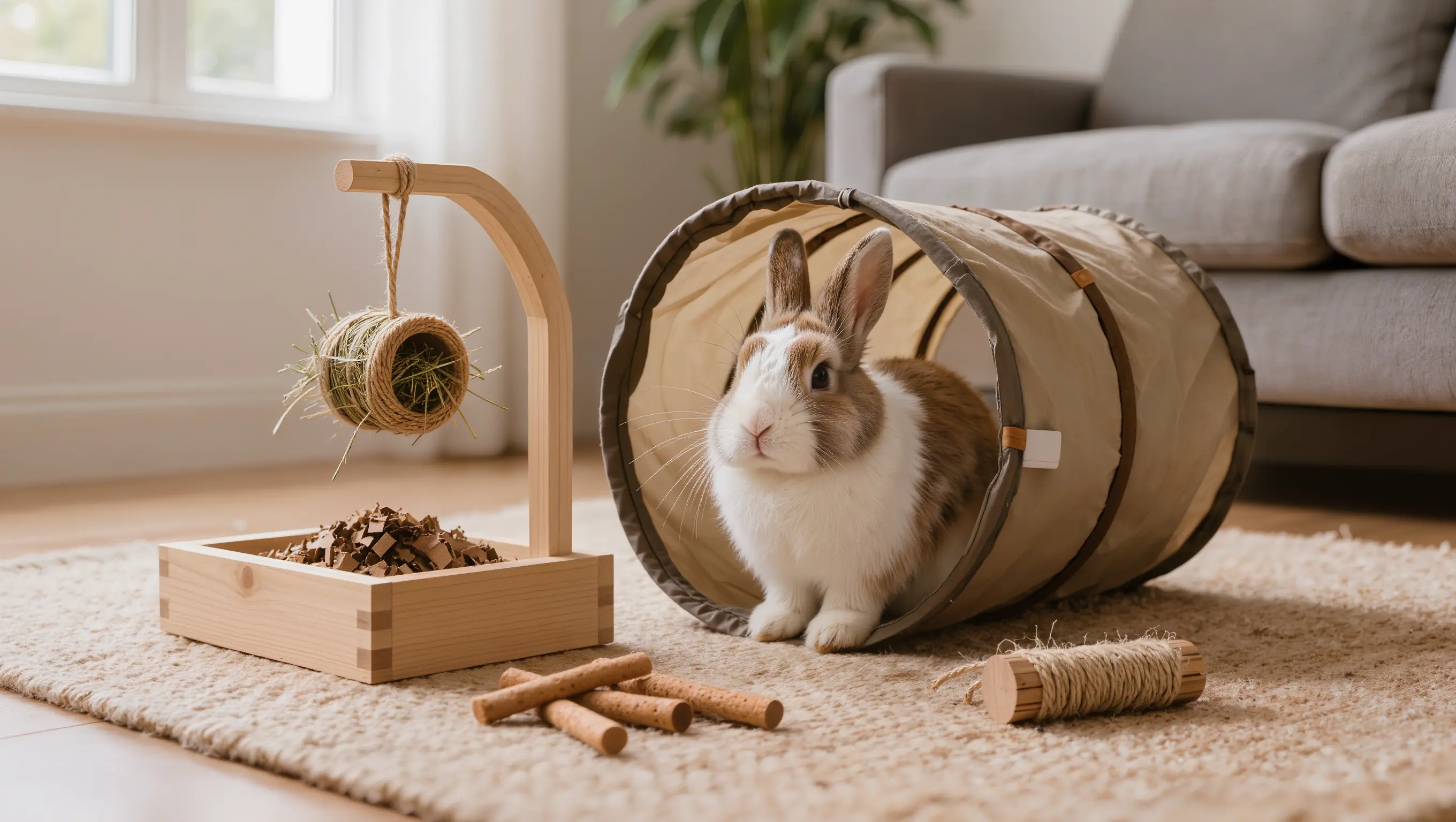
It doesn’t have to be fancy—a box filled with shredded paper, hay, or fabric scraps already works.
What matters is that it gives them:
resistance
texture
something they can interact with physically
Compared to chew toys, digging toys tend to release more energy and reduce that “restless” feeling much faster.
Foraging toys: turning feeding into an activity
Another thing rabbits naturally do is search for food, not just eat it. When food is always placed in the same bowl, in the same spot, every day, that part of their behavior disappears. And with it, a big source of mental stimulation. Foraging toys—or even simple DIY setups—bring that back.
You can:
hide pellets in hay
scatter small portions around their space
use toys that require a bit of movement to access food
This turns eating into a process instead of a moment. And that process is what keeps them engaged.
Tunnels and hideouts: small things that change behavior
Some of the most effective “toys” don’t even look like toys.
Tunnels, soft hideouts, or anything they can run through and retreat into often get used more than expected. Rabbits like having movement paths and safe spots—it gives them a sense of control over their environment.
A simple tunnel can:
encourage more movement
reduce stress
create a space where they feel secure
And interestingly, once they have that, they tend to be less reactive and less destructive elsewhere.
It’s not about more toys—it’s about the right mix. A lot of people try to fix behavior by adding more items. But what actually works is variety in type, not quantity. Once those are in place, the difference is noticeable. Rabbits become more occupied, less fixated on your furniture, and overall calmer in their behavior.
Rabbit Tunnel Toy for Indoor Play and Hideouts
£15.25 £24.08

Why Rabbits Actually Use It
Instead of treating this as just another toy, I see tunnels as something that changes how rabbits use space. Earlier we talked about movement, curiosity, and the need to feel secure—this is one of the few items that touches all three at once.
Rabbits naturally move in short bursts—run, pause, hide, repeat. A tunnel gives them a path to do that. It’s not just about play, it’s about having somewhere to go. Once that option exists, they tend to move more and stay less fixated on corners, carpets, or furniture.
What Changes After Adding One
From experience, the difference shows up in small ways. Rabbits start doing short runs through the tunnel, using it as a pass-through or a resting spot. That alone can reduce restless behavior, because they’re no longer stuck in an open, undefined space.
How I’d Use It
I usually place the tunnel along a wall or connect it to a hideout area, so it feels like part of a route rather than a random object in the middle. If there’s enough space, pairing it with a digging box nearby works even better—it creates a simple but effective activity zone.
Before You Add One
Make sure there’s enough surrounding space for movement, not just the tunnel itself
Avoid placing it in high-traffic or noisy areas at first
Give it a bit of time—some rabbits take a day or two before they start using it regularly
If your rabbit ignores it at first, I’ll usually toss a bit of hay inside or near the entrance. That small interaction often turns it from “new object” into something worth exploring.
Where to find toys that actually work together
If you’re trying to build that kind of setup, it helps to look beyond single products and think in combinations.
Voghion makes that easier—you can browse different types of toy for rabbit in one place, from chew items to digging boxes, tunnels, and feeding toys. Seeing them together makes it easier to understand how they fit into a complete setup, rather than buying things one by one without a clear plan.
Once rabbits have enough to do, their behavior shifts in small but noticeable ways.
It’s not that they stop having personality. It’s that their needs are finally being met.
And most of the time, that starts with realizing: chew toys were never the whole picture.